
Sliding Scale for Collective Liberation
Offering a sliding scale for classes and products comes from my belief that all beings deserve dignity and my commitment to our collective liberation.
I desire communities that stretch to and turn towards each other with love and generosity. Each of you are beautiful, wild, and big hearted beings called to practices of love. Together we can enable folks from a diversity of economic backgrounds to take part and belong.
As I offer my work internationally, and live and work in multiple countries, I acknowledge there are vast differences in class, earning power, and currencies between places and I may not always be able to adapt to local economic realities.
The paradoxical nature of power, rank, and privilege is that it causes those of us who benefit from more of it to be blind to its existence and impact, while those of us who hold less of it are unable to not be impacted.
Awareness is our access point.
As you read on, if you notice yourself checking out, or feeling uncomfortable, I invite you to bring curiosity to these cues and explore where you may be unconsciously wielding class privilege and where you may have internalized class oppression.
᠅
Alex J. Cunningfolk has written beautifully and comprehensively on the sliding scale model. I have borrowed liberally from her writing with some adaptations below:
Class and economic justice are topics that lots of folks struggle to talk about in the United States because most of us aren't educated in schools or the culture at large to talk about money, access to resources, and what class actually is. Class, of course, cannot be understood as an isolated experience, but is part of the complex interactions of race, gender, ability, privilege, sexuality, and the myriad of identities we all hold. I think the sliding scale is a great way to begin a conversation about class because it frames the discussion from the standpoint of access. I wrote this article, in part, because it was really hard to find any online resources about creating and using a sliding scale. So, these are my thoughts, and they are a work in progress. Please feel free to share, cross-post, and incorporate information (including the graphics) from this article onto your site - I just ask that you give credit to keep the conversation going.
First, if you're unfamiliar with what class is and why it matters, please visit classmatters.org to learn more.
The sliding scale is a tool that allows for a product or service to be obtained at multiple price points based on the circumstances of the purchaser. This method allows folks who would most likely be priced out of something to have the chance to take part in it. It also seeks to address the systemic inequalities of class in our culture.
The sliding scale represents the idea that financial resources, including income, are not and should not be the only determining factor in whether or not someone can access services/care/etc. I offer this as a commitment to serving individuals and/or communities that would otherwise not be able to afford the services. As a small business, I do not receive any outside funding to supplement sliding scale discounts, so I must take into account what I am able to offer and still be able to support myself.
For a sliding scale to work it relies on the principles of truthfulness, respect for complexity, and accountability. I do not ask for income verification. I trust you to be honest. Community thrives when accountability is a central value, because that is where trust grows and depth work can be done. Teachers deserve to get paid and students deserve classes which recognize the multiple realities of economic access and privilege that exist.
Recently, someone shared with me the idea of sacrifice versus hardship when examining access. If paying for a class, product, or service would be difficult, but not detrimental, it qualifies as a sacrifice. You might have to cut back on other spending in your life (such as going out to dinner, buying coffee, or a new outfit), but this will not have a long term harmful impact on your life. It is a sacred sacrifice in order to pursue something you are called to do. If, however, paying for a class, product, or service would lead to a harmful impact on your life, such as not being able to put food on the table, pay rent, or pay for your transportation to get to work, then you are dealing with hardship. Folks coming from a space of hardship typically qualify for the lower end of the sliding scale. I find the idea of sacrifice versus hardship to be a very useful nuance when talking about class and access because it recognizes and respects that paying for something might still be a challenge even if it is just a short-term one, while giving appropriate space for those who are dealing with financial hardship.
Here is a general guidelines about how I currently price my sliding scale and to help you determine where you fall on it.
The highest dollar cost reflects the true cost of the class or service. It is the cost that the practitioner would charge all students in the absence of a sliding scale. If you have access to financial security, own property or have personal savings, you would not traditionally qualify for sliding scale services. If you are able to pay for "wants" and spend little time worried about securing necessities in your life, you have economic privilege and power in our community. This price is for you.
The middle cost (when there is one) reflects the practitioner's acknowledgement that paying the full cost would prevent some folks from being able to attend, but who do not honestly find themselves reflected in either descriptions for the highest cost or the lowest. If you are struggling to conquer debt or move away from paycheck to paycheck living but have access to steady income and are not spending most of your time thinking about meeting basic needs such as food, shelter, medical care, child care, etc., you belong here. If you, however, can ask others for financial support, such as family members, partners, or friends, please consider using those personal resources before you use the resources of the sliding scale and limit opportunities for others.
The bottom cost represents an honest acknowledgment by the practitioner that there are folks whose economic circumstances would prevent them from being a part of classes if there was not be a deliberate opportunity made for them to access services at a cost that is reflective of their economic realities. If you struggle to maintain access to needs such as health care, housing, food, child care, and are living paycheck to paycheck, you belong probably belong here and you deserve a community that honors your price as equal an economic offering as the person who can pay the highest tier. Even when the lower tier is still prohibitive, I will work with folks to offer extended payment plans and other solutions.
There is a limited amount slots for products, services, and classes offered at the middle and lower end of the scale. Please be mindful that if you purchase a price at the lowest end of the scale when you can truthfully afford the higher ticket prices, you are limiting access to those who truly need the gift of financial flexibility. Being honest with yourself and your financial situation when engaging with sliding scale practices grows strong and sustainable communities. It also respects the work of teachers and creators, like myself, who also have real costs of living.
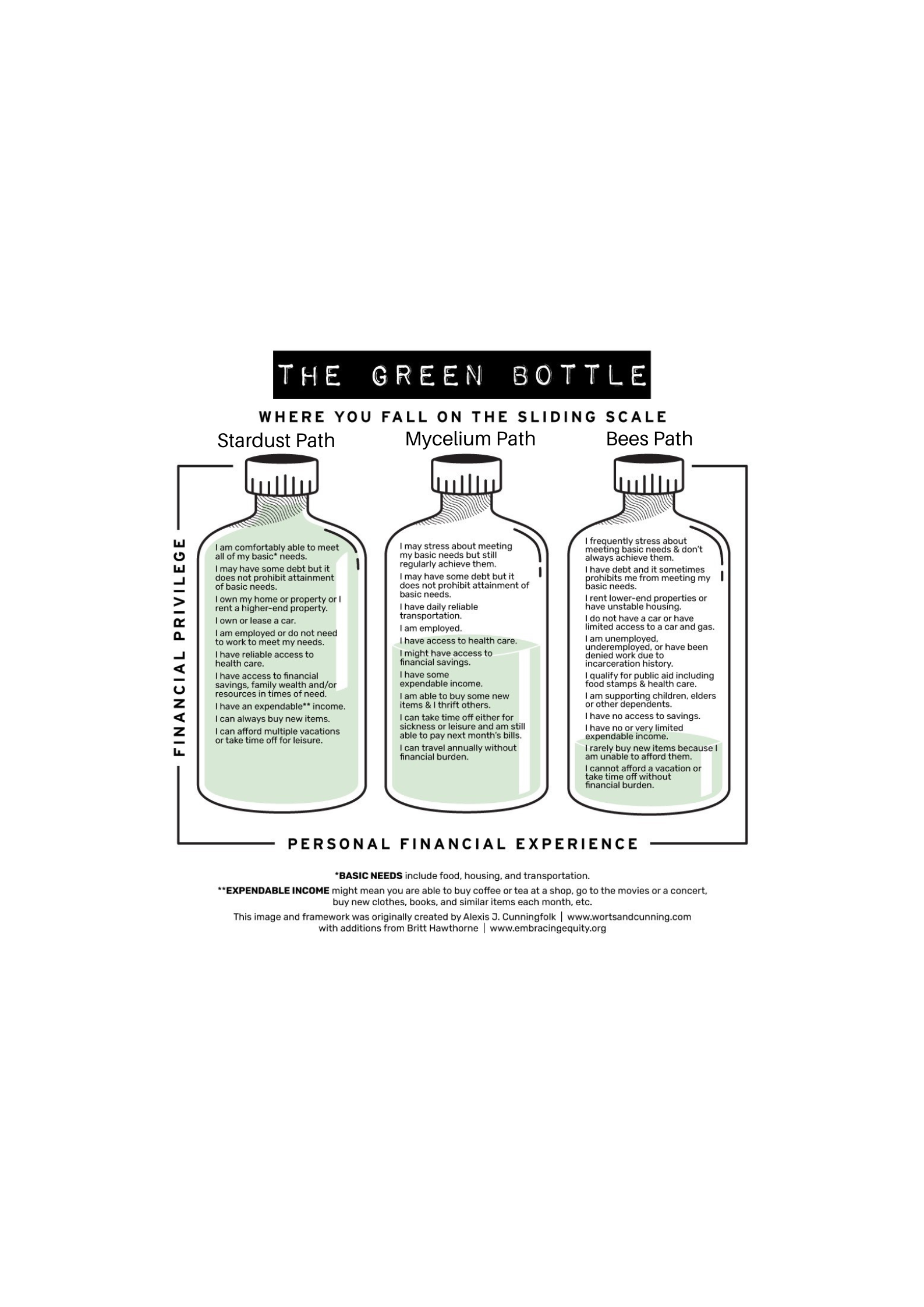
Above you'll find a graph illustrated with three bottles (click to enlarge). Each bottle contains sentences that describe a person's current financial experience and class. The bottle on the far left is full of beautiful green potion representing the upper end of the sliding scale spectrum. Folks who identify most with the statements in the far left bottle qualify to pay for class tickets at the upper end of our sliding scale. The middle bottle represents folks who sometimes can pay for the upper end of the sliding scale, sometimes the middle, and sometimes the bottom half (depending on how many sliding scale options are available). The bottle on the far right represents the lowest end of the scale and folks who qualify to purchase class tickets from the bottom of our price spectrum.
For ease of reading, here is the text from each of the bottles in the above graphic:
Top of the Scale (or the left bottle) “Stardust path”:
I am comfortably able to meet all of my basic* needs
I may have some debt but it does not prohibit attainment of basic needs
I own my home or property OR I rent a higher-end property
I own or lease a car
I am employed or do not need to work to meet my needs
I have regular access to health care
I have access to financial savings
I have an expendable** income
I can always buy new items
I can afford an annual vacation or take time off
Middle of the Scale (or the middle bottle) “Mycelium path”:
I may stress about meeting my basic needs but still regularly achieve them
I may have some debt but it does not prohibit attainment of basic needs
I own or lease a car
I am employed
I have access to health care
I might have access to financial savings
I have some expendable income
I am able to buy some new items & I thrift others
I can take a vacation annually or every few years without financial burden
Bottom of the Scale (or the right bottle) “Bees path”:
I frequently stress about meeting basic needs & don’t always achieve them
I have debt and it sometimes prohibits me from meeting my basic needs
I rent lower-end properties or have unstable housing
I do not have a car and/or have limited access to a car but I am not always able to afford gas
I am unemployed or underemployed
I qualify for government assistance including food stamps & health care
I have no access to savings
I have no or very limited expendable income
I rarely buy new items because I am unable to afford them
I cannot afford a vacation or have the ability to take time off without financial burden
* Basic Needs include food, housing, health care, and transportation.
** Expendable Income might mean you are able to buy coffee or tea at a shop, go to the movies or a concert, buy new clothes, books, and similar items each month, etc.
᠅
At the end of the day, the sliding scale thrives on trust. Trust is a pretty amazing thing. I trust you to be honest in your assessment of your economic reality. Since the sliding scale is a tool of accountability, it is an ongoing conversation and I remain committed to helping folks figure out how to talk about their own economic experiences, since it has been such a helpful language to learn on my own journey.
Please feel free to share, cross-post, and incorporate information (including the graphics) from this article onto your site - I just ask that you give credit (my name, Alexis J. Cunningfolk, and link to this post) to keep the conversation going. Because we need to keep talking about money, equity, and how we make it better for all.”